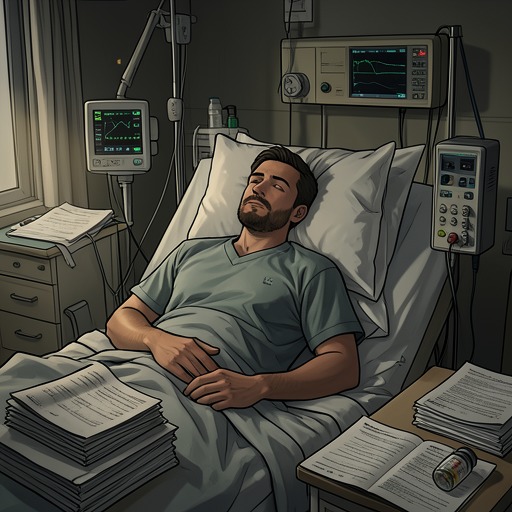
Mickey Haller’s recovery from gunshot and surgical injuries
The Brass VerdictMickey Haller’s recovery from a gunshot wound and later surgical complications shapes his return to legal work, which proceeds by fits and starts rather than as a simple restoration of his former capacity. After coming back too soon, he developed further pain and underwent additional surgery; complications then kept him away from practice. When he begins working again, a hybrid wheeled bag, a careful account of his time away, and the strain of a new caseload all make recovery visible as an ongoing condition, not a completed episode.
The injury and the cost of returning too soon
Haller explains his medical history to a judge while answering questions about his return to practice. A couple of years earlier, a case involving Louis Roulet had ended with Haller being shot. He returned to work before he was ready, despite having been wounded in the abdomen. He later developed a hernia, and an operation for it was followed by complications and another operation. The sequence, as he recounts it, turned an attempted comeback into a period in which he was again unable to work as he intended.
The account draws a distinction between the first return and the later one. The judge recalls news coverage of Haller’s earlier return to the profession, but Haller explains that this apparent recovery had been premature. His subsequent decision to wait until he was sure he was ready is therefore not simply a pause in his career: it follows a concrete lesson about what an early return had cost him. The narrative leaves the precise medical details behind and concentrates on the consequences for his ability to practice.
Time away and a renewed professional life
During the period away from law, Haller could afford to take time before starting over. He had savings and received an insurance settlement, which meant that immediate financial need did not force him straight back into work. He tells the judge that he was preparing to advertise in the Yellow Pages when the unexpected transfer of Jerry Vincent’s practice changed his prospects. Vincent had named Haller in a professional arrangement for covering cases and had filed a motion allowing the practice to pass to him if Vincent became incapacitated or died. The transfer gave Haller the first opportunity to take on Vincent’s cases, though each client remained free to choose another lawyer.
That opportunity brings recovery into tension with workload. Haller is not returning to an empty practice or a gradual schedule: he takes on a substantial stack of files and must prepare for the work already attached to them. He carries the files from Vincent’s office to his car, conscious of the setup still required across the new caseload. The professional opening is real, but so is the immediate demand it places on someone who has only recently decided he is ready to work again.
A working measure of strength
The physical terms of Haller’s return are captured in the bag he uses to carry the files. It can be worn as a backpack, carried by its handle, or pulled on wheels with a telescoping handle. He chose it while planning his comeback because it could accommodate days when he felt strong and days when he felt weak. By the time he is carrying Vincent’s files, stronger days have become more common, and he thinks he could manage with a conventional leather briefcase. He keeps the hybrid bag anyway.
The object does not mark a definitive cure. Its different ways of carrying weight preserve the possibility that his capacity will vary, even as the balance has shifted toward strength. Haller also gives the bag’s Suitcase City logo a meaning beyond its practical design: for him, the imagined place on the bag is Los Angeles, a city where people often remain ready to leave. That association belongs to his reflection on the city, but the bag’s practical presence in the scene is specific: it holds the files of a new practice and adapts to the condition of the person carrying them.
Pain, addiction, and the return of pressure
In describing his medical history to the judge, Haller leaves out his addiction to pain pills and his stay in rehabilitation. The omission is deliberate in the conversation: the judge responds sympathetically to the account of his injuries and surgeries, while the fuller history of addiction remains unspoken. Elsewhere, Haller makes that history explicit when speaking with Patrick Henson. He recounts that he once drove his eleven-year-old daughter home while taking 320 milligrams of OxyContin a day. The memory turns his past dependency into a measure of the danger he recognizes in another person’s efforts to stay clean.
Haller and Patrick agree to support one another through the next few weeks, talking if either begins to feel the pull of using again. Haller does not tell Patrick that he may need the support more. The growing caseload has begun to weigh on him, and he recognizes his own desire for the distance that pills once provided from the demands of ordinary life. His return to work, then, is not presented as proof that every part of his recovery is secure. The professional workload that confirms his renewed capacity also presses against a known vulnerability.
Recovery as an unfinished return
The account of Haller’s recovery holds improvement and risk together. He can work, carry a large collection of files, and take on the responsibilities transferred from Jerry Vincent; he also remembers how an earlier return brought further medical trouble, and he notices the renewed pull of pain pills under pressure. His flexible bag and his agreement with Patrick register different kinds of adaptation: one accommodates physical strength that varies, while the other acknowledges that maintaining recovery can require support from another person.
The evidence does not resolve Haller’s condition into a final declaration of health. Instead, it places him back in professional motion while retaining the history that makes the return precarious. Recovery is measured in practical choices—waiting before resuming work, using equipment suited to changing strength, and agreeing to speak up when temptation returns—rather than in a single moment when the consequences of injury and treatment simply disappear.